Sunday, December 28, 2014

Mental Math

There's a type of pain a brain will suffer only from mathematics, and I had a splitting headache of that kind in high school once as I struggled with some concept I couldn't quite master.  I was good with numbers at that time, in the most advanced classes and really enjoying it -- but when I approached the teacher for help I was summarily turned away, I don't know why. Maybe the guy was having a bad day. But I needed help and wasn't getting it, so I finished that class as best I could and didn't take another, for a long long time. And that was too bad -- because although math does hurt, it's really really cool.

Recently I took a course called Mental Math out of Harvey Mudd, with Professor Arthur Benjamin through The Great Courses, an online business that is remarkably solid.  It was the tenth course I've taken through TGC and one of the best.  As it turns out, these skills are so useful I wish I had them long ago.  Benjamin starts most of his 12 lectures by demonstrating, to a live audience, some pretty impressive feats.  And then he breaks them down into digestible parts.   

Some of the lessons were more or less common sense.  Like breaking down a problem like 19*32 to (20*32) - 32.  That's 608.  Or that multiplying a single digit by 9 results in a product starting one less than the digit followed by its complement to 9.   9*8=72     9*3=27 and so on.

Some lessons were approximate.  If you want to check the order of magnitude of a multiplication answer, add the number of digits on both sides.  Your product will have that many digits or one fewer.  Which?  If the product of the two largest place digits is 10 or more, it'll be the sum of the digits.  If it's four or less, definitely the sum minus one.  Example: 6475*480.  Since 6*4 >=10, the product has the full 7 digits.  If we multiply 1234 * 298, since 1*2 <=4, the product will have 6 digits.  Check it, it's true.

Multiplying by 11 is freaky easy.  11*54=594 .. that 5 and 4 look familiar?  The 9 is the sum of them.  11*32=352.  11*18=198.  That is, 11*AB=A  A+B  B and it works for large numbers too!  11 * ABCDE is A   A+B   B+C   C+D   D+E  and E -- 11*2345= 25,795.  It only gets a little tricky when the two numbers add to more than 9, like 11*789, in which case it's 7 7+8  8+9   9  or 7  15  17  9.   Carry the 1's right to left and you easily see 8,679.  That's pretty much it for 11zies.

It turns out the way I learned multiplication is the most drawn-out way to do it.  Here's another way, the Criss Cross method: take a small one first: 21*47.  Right to left it's 1*7 = SEVEN.  (1*4)+(2*7)=18, that's EIGHT, carry a 1.  This is followed by 4*2 [plus the carried 1] is NINE, so the answer is 987.  Here's about as bad as it gets, with more carrying:  37*62.  7*2=14, FOUR carry the 1.  [ (7*6=42)+(3*2=6)]=48, plus the carried 1 =49 that's NINE carry the 4. Finally, 3*6=18 plus the carried 4= 22 ... so the answer is 2294.  In other words AB*CD  is  AC, [(B*C)+(A*D)], then B*D, with a little bit of carrying.  For bigger numbers this works, too, but you'll probably need paper ... I'll show you ABCD*EFGH.  Start with the ones: D*H, then the next product digit moving left comes from (C*H)+(D*G).  Then BH+CG+DF.  Then AH+BG+CF+DE, then AG+BF+CE, then AF+BE, then AE.  Yes it's a chore but all you write down is the answer.

Here's another way when the two digit numbers are anywhere near close together.  Let's start easy: 43*42.  Look for a nice tens number nearby (40).  43 is +3 from 40 and 42 is +2 away.  Take 43 and
add the +2 (from the 42-40), OR the 42 plus the =3.  Either way you get 45.  Now 45*40 is easy to figure in your head ... as easy as 45*4, it's 1800.  Then just add the multiplication of the two adjusters: 2*3.  So the answer is 1806.  The same thing works when one or both numbers are below the target tenzie.  Try 28*34.  It's just 30*32=960 ... plus (-2*4) ... 952.  See, I added 4 to 28 or subtracted 2 from 34 to get the 32 to multiply by 30.  If both numbers are below the target, you add their product of course, because a negative times a negative is a positive.  Example: 38*36 = (34*40)+(-2*-4) = 1360+8=1368.  

If you're multiplying two numbers that start the same, and the last two numbers add to 10 there's a super easy way.  67*63, take the 6 and multiply by (6+1), then concatenate the product of 7 and 3.  That's (6*7),(7*3) ... 4221.

To multiply any two numbers between 10 and 20, you can do it this way.  Say 17*14.  Take 17+4=21, times 10 (210) then add 7*4 ... it's 238.  It works either way of course -- you could go 14*17, 14+7=21, times 10 and add the same 4*7.

When it comes to division, I learned the old long division, which is just a waste of time when the divisor is small because in that case short division on paper is just the same and so much quicker.  Why write all those numbers?  If you want to get the order of magnitude of your quotient correct, the length of the answer is the difference in length of the number and divisor, or sometimes that +1 digit.  To determine whether to add the 1 digit just compare the two largest digits.  If that for the number you're dividing is smaller, it'll be just the difference in digits.  E.g., 6543/739, because the 6 is smaller than the 7 it  will yield a 1 digit number (8.84...); but the result of 5439/284 will be two digits (19.15...).  Because 5 is larger than 2. 

If you want to know if something is divisible by 2 just look at the one=place digit, everyone knows that.  6748 is, 7643 isn't.   But it'll be divisible by 3 if the sum of all the digits are a multiple of 3.  Try 3471, that adds to 15, so 3471 divides neatly by 3.  A number is divisible by 4 if the last two digits are divisible by 4.  By 5 if the last digit is 5 or 0, of course.  By six if it's divisible by both 2 and 3 (see above).  7 is the most complicated: Take off the last digit, double it, and subtract it from the rest.  E.g., 112?  2 doubled is 4 and 11-4=7.  Since that's a multiple of 7, 112 is too.  It's divisible by 8 if the last three digits are divisible by 8.  Nine is like three; sum the digits and if that is a multiple of 9, you're good.

Another way to do 7 is this.  By example, take 1234.  Add or subtract a multiple of 7 to get to get a 0 in the one's place: 1234-14=1220, then kill the 0: 122.  Do it again: 122+28=150, and kill the 0.  15 is not divisible by 7, so neither is 1234. This trick works for any number ending in 1, 3, 7, or 9.  Is 1472 divisible by 23?  Well, 1472-92=1380 ... 138+92 =230.  Kill the 0 and you get 23.  So yes it is.  

Besides being fun, there's some immediately practical information in this course.  To calculate change just take the complement which adds to 9 for every digit except the last one, which adds to 10.  So pay $10 for something that costs $1.32?  $8.68 change.  Costs $6.98?  It's $3.02.  Just add another $10 if you paid with a $20 bill.  I now can beat just about any checkout clerk.
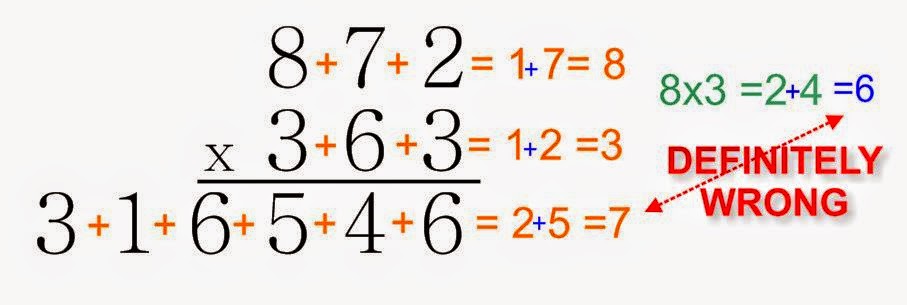

Here's another really freaky cool trick.  Let's say you multiplied two very large numbers: 1,246*35,791=44,595,586 .  To check your work add 1, 2, 4, 6= 13, then add that 1 and 3, to get 4.   Then add the 3, 5 , 7, 9, 1 that's 25, and 2+5=7.  Then since you're multiplying, multiply the 7*4=28, the 2+8=10 and the 1+0 =1.  That's a lot of collapsing, but it's worth it.  Compare this to the sum of 4, 4, 5, 9, 5, 5, 8, 6= 46 and 4+6=10 and 1+0 =1.  If the numbers match the the answer is most probably right!  If the numbers don't match, it's certainly wrong, like this: Does 27*43= 1151?  Well, 9*7=63 and 6+3=9 ... and the digits of 1151 add to 8.  So it's WRONG, for sure.  This trick works for subtraction just the same.

Squaring two-digit numbers that end in 5 is easy because the product always ends in 25.  Take 85 squared.  8*9=72, so it's 7225.   X5squared is [X*(X+1)] and tack on 25.   Wala. Works for multi-digit numbers too.

Vedic Division is really pretty extraordinary.  It works best when dividing by a 2-digit number that ends in 9 or another high number.  Say, 47869/49.  You change the 49 to 50 and just divide by 5, working left to right. 47/5 is 9, remainder 2. But because we fudged a bit to get 5, instead of dividing 28 (the carried 2 and the next digit, 8) by 5 you first add the 9 from the quotient to 28, so the next is 37/5 =7R2, then (26+7=33)/5=6R3 and 39+6=45 ... so the answer is 976 R45.  If your divisor ends in 8 then double the previous digit in the quotient; if 7, triple it.  If it ends in 1, subtract the previous quotient; if in 2, subtract it twice.  If that's not clear, buy the lectures.  They're worth it, I assure you.

One of the most fun lessons was figuring out the day of the week for any date.  You have to memorize a few things, like add 1 for the 1900s, 3 for the 1800s, 5 for anything in the 1700's and 0 for the 1600s or 2000s.  And you have to memorize a number among 0-6 for each month.  January is 6, Feb 2, M 2, A 5, M 0, Ju 3, Jul 5, A 1, S 4, O 6, N 2, Dec. 4.  Pure memorization, though there are tricks you can use.  Then you do it this way.  Let's say Feb 12 1809 -- Charles Darwin's birthday.  3 for the 1800s plus 2 because there were two leap years by '09 (9/4, throw out the remainder), then add the 9 itself ... 14.  For Feb add 2, that's 16.  Then 12 for the day, we're at 28.  Divide by 7, the R is what we're looking for.  28/7=4R0.  You start at Sunday with 0, Monday as 1, through Saturday (6).  Darwin was born on a Sunday.  This gets easier when you start dropping any multiple of 7 at any time, and drop any multiple of 28 years between the years 1901 and 2099.  Nov. 6 1975? It's 75/4=18 leap years and 75-56 (28*2) is 19.  19+18 is 37, drop the 7s, that leaves 2.  Add another 2 for Nov and 6 for the 6th, and 1 for the 1990s. That's 11.  Drop a 7 and it's 4, that's Thursday.  If you're early in the millennium, it's real easy.  What day is July 4 in 2015?  27/7 =3R6 Saturday.  

There are just a couple of twists.  On leap years subtract 1 from the months Jan and Feb, so they are 5, and 1 respectively.  And this astronomical correction I was not even aware of: any year ending in 00 does not leap, unless it ends in 400 -- then it does.  

Many of these tricks, if you actually do them in your head, require holding numbers while you work on others.  That gets confusing.  The Major System helps, because it converts numbers to letters.  You basically read numerals like the alphabet instead.  1=T/D/Th, 2=N, 3=M, 4=R, 5=L, 6=G/sh/ch, 7=K/hard G, 8=F/V, 9=P/B, 0=S/Z   Words are much easier to remember than strings of digits, and when you have to keep both in your head, they are less likely to get confused.  I've been using the Major System for awhile, so I was gratified when Benjamin recommended it.

I've combed through much of my notes for this little summary -- but there's more, and Professor Benjamin will explain it much betters.  He took me to a few places, near the end, which almost started up that old headache again.  But it was worth it.  I recommend the video version of the course, not the audio, because there is quite a lot of visualization.   If you buy it, wait for a sale, and you'll need a notebook.  Benjamin is earnest, enthusiastic, well paced, and clear. He gives excellent examples, explains why these things work, and demonstrates almost inhuman mastery of these skills, sometimes thinking aloud so you can see his process.  It's so much fun.  Here's a link:  http://www.thegreatcourses.com/courses/secrets-of-mental-math.html


Friday, July 4, 2014

Memes are the new Genes

After Darwin struck upon evolution he kept it pretty much to himself for nearly 20 years; he knew he was on to something big, but also that it would be vehemently opposed. If Wallace hadn’t been about to spill the beans with his similar insight, Charles may have never shared his depth of thought and impressive wealth of supporting evidence.  And although, today, while genetic evolution is about as close to fact as you can get, in the United States just a little over half accept it as probably or certainly true. According to a Gallup  poll two thirds think humans were probably or definitely created in their present form; Some groups (e.g. Republicans) seem to be moving more firmly to that view.

Why would they do that?

Well maybe it’s just not pleasant to think of one’s self coming from the muck, as resulting entirely from a series of errors, as being infused with prehistoric impulses, or as a descendant of an ape, shrew, worm, and sponge and kin to everything alive -- or even not alive -- today.  It’s particularly hard to accept if it makes one question the happier more familiar explanations of human existence.  Evidence for evolution is easy to reject when there are still magical stories to retell.

Given the resistance to something so solidly shown, it’s not surprising to me that memetics has had a rough go too, even though it also has obvious merit and deep implications.  Memetics, you might say, is the new genetics.  It’s like we are in the mid 1800s again, resisting this germ of a huge idea.  

There have been more recent books on the topic, like Tim Tyler’s Memes: The Science of Cultural Evolution (2011)and Brodie's The Virus of the Mind (2011) but I think it will be hard to beat Susan Blackmore’s The Meme Machine (1999) for a solid primer on this mind-bending train of thought.

The word "meme" has even hit popular culture;  I just Binged “Internet Meme” and found 825,000 hits.  But that's just a popular video on YouTube -- it's relevant to memetics, but in a trivial way.  Memes are more than that:: these are ideas that duplicate themselves, jumping from brain to brain.  When you retell a good joke you've heard, have you just used the joke, or has the joke used you? 

But it goes deeper; let me try to intrigue you with something more.

Consider the basics of genetic evolution: individuals are different, and the more successful ones tend to pass on the contributing genes.  Creatures that are more clever than their cohorts are often better survivors, so cleverness is rewarded and brains became larger and smarter. Memetics suggests that at some point these brains become receptive to ideas that have nothing to do with the host's survival or procreation. Humans then, are the result of two evolutionary  forces: genes which groom our bodies and brains, and memes which infect our minds.  Because ideas can influence behavior, and behavior can affect genes, while at the same time genes can affect the ability to learn -- the two forces influence one another.  But they often pull in different directions.

Meme is a shortened version of 'mimeme' which means 'imitated thing' in ancient Greek but Richard Dawkins in his 1976 The Selfish Gene wanted something shorter and a little more like 'gene'.  To be fair, Hamilton in '63 and Haldane in '55 contributed to the idea he made popular then.

Memes aren’t just any idea you might have, any emotion or feeling or creative impulse.  They are the thoughts that can transfer from person to person by imitation. Although they are not perfectly analogous to genes, they have some important things in common.  They replicate. They change.  And they matter.  That's enough for natural selection to take hold, as Dawkins explained when he coined the term meme in his 1976 book The Selfish Gene  and this means they move and change on their own. They are like viruses, which depend on living cells but move between them freely. Blackmore puts it this way:  memes are unleashed when brains become sophisticated enough to 1) transform an idea from one point of view to another, 2) decide what to imitate, and 3) produce matching behavior.

It's tempting to try to compare memes to genes directly, but this has been one stumbling block in their acceptance. Stephen Jay Gould called memetics a “meaningless metaphor” and others have been harsher still.  But memes aren't like genes.  Why would they have to be?

Blackmore uses the analogy of a recipe for a meal to make this point.  If it is written down and photocopied it is very much like genetic code – each person might make a little change, by taste or error, but with every generation the code is reset.  If it is passed on by observation or verbally, however, or jotted down on the back of an envelope, then it is not like genes because any error or alteration will persist.  In that sense it’s Lamarkian [Lamark believed in heritability of acquired characteristics].  Either way, the recipe is a meme. 

Is the whole recipe the meme or just each ingredient?  A similar question is central to genetic evolution (is it genes, is it organisms, species or groups which are selected?).  But Blackmore answers “any or all of the above.”  The key to memes is imitation, which she carefully distinguishes between contagion, social learning, and imagination. She contrasts the prevailing view of evolutionary psychologists and her own, and at times she even disagrees (refreshingly) with Pinker, Dawkins, and Dennett -- all of whom are my main guys, by the way.  There are many references and citations.

Many who have supported memetics assume that memes mainly inform genetic change – in other words, that while ideas evolve their function is to affect genes.  So we had the idea to leave the forest for savanna, and genes were then groomed for bipedalism.   Memes may affect us, but through genetic selection.

But this can't be right.  Memes don’t always agree with genes. Sure, in a culture that is insular, a tribe that is small, or when families are close-knit, the flow of information and directives is mainly vertical, generation after generation.   That’s the way the genes flow too, so in those situations there is no conflict -- ideas that increase survival and procreation will propagate and thrive if the tribe does too.  On the other hand, for example, if an Amish household adopts the idea of celibacy, both that family line and the idea are not likely to fare well.

This may be a reason to distrust neighboring tribes, to create and reject the "other" -- they may have ideas which would be invasive to our own.

Because when information flows horizontally memes travel in a cross-current to genes.  Their interests (which is ultimately self propagation) may be quite different. Though some ideas are aligned with genetic survival, some are irrelevant to it, and some fly in the face of genetic advantage and this is where it becomes most interesting and useful to understand.  Consider family planning, contraception, abortion, homosexuality ... genes would "object" vehemently to these notions, yet memetics would predict that they could thrive.

Happily, many of these ideas are testable.  Is internet connectivity correlated to use of contraception?  Is abortion a greater taboo in authoritarian societies? Is a rigid society more socially conservative? Are gay rights more common where press is unfettered? At the time of the writing the answers were not known.

If memes duplicate selectively, what makes one more likely to be repeated or imitated than another?  This has been carefully studied by advertisers and politicians.  Currency, novelty, alignment with preexisting ideas, repetition, danger, contrast, association, utility, sequence, context, timing.  All of these things affect how convincing or coercive a message will be.


One of the hard facts about genes are that they aren't always nice to their host.  It's replication of the genes, not the creature, that drives evolution and sometimes interests clash between genes and their organism. There are lots of examples how humans even are full of quirky errors -- the way the eye is wired, for example, leaving a blind spot.  Genes aren't aligned with groups, either: a 50:50 sex ratio is a good example of this, as I've explained in a previous post.  Likewise, memes aren’t always nice to genes and they aren’t always particularly nice to their humans. Just as a virus jumps from host to host, memes do the same, with similar disregard for the health of their host beyond the meme's ability to spread itself more widely. 

Darrell Ray wrote The God Virus (2009), which made fairly close and very interesting analogy of the spread of religions (although he didn't use the term meme) to viruses.

At the heart of the argument Blackmore presents, is imitation. 
"Once imitation arose three new process could begin.  First, memetic selection (that is the survival of some memes at the expense of others). Second, genetic selection for the ability to imitate the new memes (the best imitators of the best imitations have higher reproductive success).  Third, genetic selection for mating with the best imitators." (116)
There is a chapter on how memes may have been the root cause of the jump in brain size about 2.5 million years ago, about when toolmaking began.  Her speculation, to summarize, is that this was the dawn of true imitation and genes that assisted imitation were quickly groomed by sexual selection.  David Deutsch said something similar in The Beginning of Infinity.  Brain size, Blackmore speculated, may be like peacock feathers: peahens took a liking to large feathers and feathers got larger and larger and larger in a crazy feedback loop called runaway evolution.  "We need not take it for granted," she said, "that big brains, intelligence and all that goes with them are necessarily a good thing for the genes." (p 120)

Another leap, about 100,000 years ago -- language -- also may have been directed by memes. From the meme's perspective "a silent person is an idle copy machine waiting to be exploited." (p 84).  A scandal, horrifying news, useful information, anything that taps into sexual needs or increments social status are memes just pressing for expression.   Those individuals who could better express themselves would have the advantage and so language itself emerged, she argued -- in the service of imitation.

She takes on altruism (Chapters 12 and 13), cults (Chapter 14) religion (15), and the impact of the internet (16).  In the clinching chapter Blackmore speculates that self awareness itself (i.e., consciousness) may have been born of memes, as so: sense of self creates a sense of ownership, including ownership of ideas, hence a proponent of those ideas, thus giving a meme an advantage by grooming a sense of self. "The self," she wrote, "is a great protector of memes."

Could we be the battlefield for competing memes, and their soldiers as well?  Do we take ideas in, convince ourselves that they are ours, and then protect them as possessions so we actively promote them to others? But by this new way of thinking, ideas seem a bit like parasites.

But there's little wonder (as I've noticed), that the science of memetics is hardly popular, and even the subject of derision.  I mean half adults in the United States don't accept genetic evolution --are we really ready to consider that news, the gossip, lessons from mother, our hobbies, knowledge, trades, warnings, friendly advice, careers, our avocations, preoccupations and all of the rest are not only outside under our control .. but that might be taking us for a ride?

I don't think so. 

Despite the small foothold, evident in the graph to the right (the two scales are wildly different of course), memetics as a science is probably not going anywhere fast.  But Blackmore suggests there might be some personal advantage to considering it anyway.  If you ponder your own thoughts -- and she recommends meditating -- to trace their origins, it may help put things in a better more healthy perspective. Modern life may be stressful, she suggests, not because we want to take advantage of all the wonderful new opportunities and ideas, but because the ideas want to take advantage of us.


Certainly food for thought.
The Meme Machine Susan Blackmore, 1999.
264 pp references, index.